- contact@verticalserve.com
- Continuous compliance, proven every hour

Vendors & risk
Third parties and risk, tied to your controls
Every vendor has a criticality, the data it touches, its assurance report and a review cycle. Every risk has an owner, a treatment and the controls that reduce it.
Inventory
The vendors you know, and the ones the IdP found
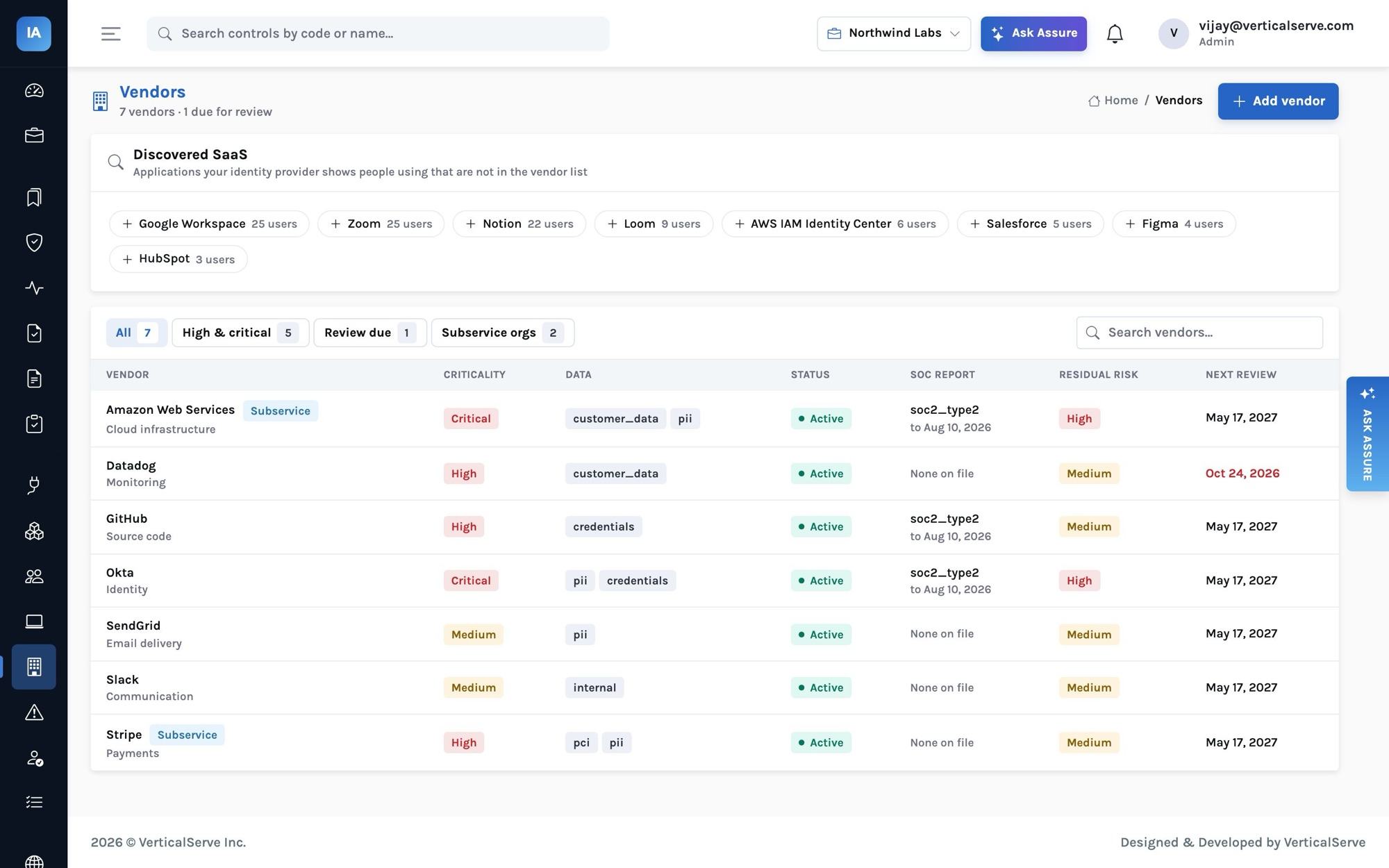
Applications your identity provider shows people using, but which are not in the vendor list, appear as Discovered SaaS with their user counts: one click adds them. Each vendor records criticality, the data types it touches, whether it is a subprocessor (listed on your Trust Center) and whether it is a subservice organization for your SOC report.
Inherent risk follows from criticality and data: critical, or high with sensitive data, is high. Critical and high vendors are due a review every year, others every two.
Reviews
A SOC report review that records what it places on you
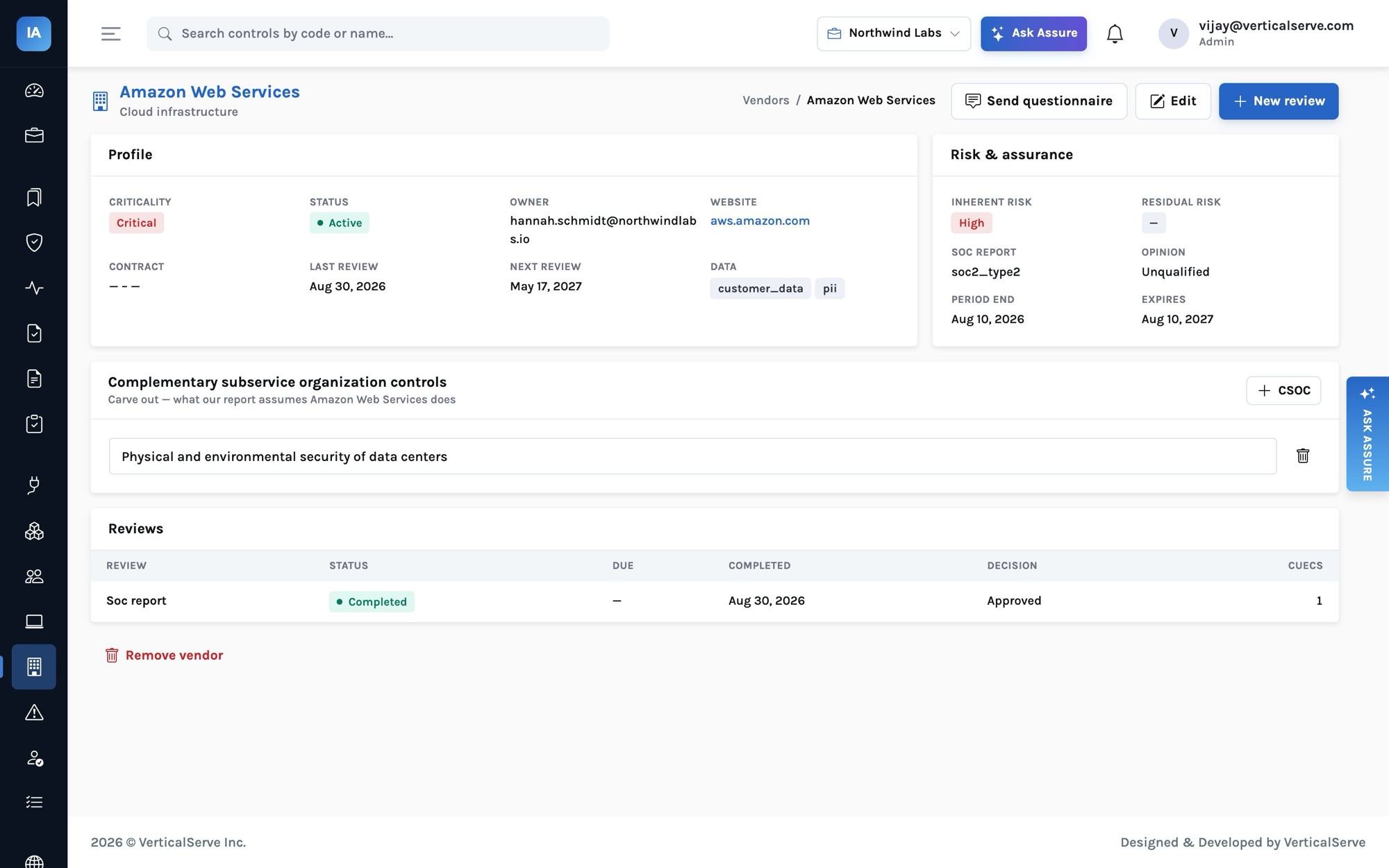
A review is a security review, a questionnaire (twelve standard questions to send) or a SOC report review. Completing a SOC report review records the report type, opinion and period end on the vendor, sets its expiry a year after the period end, and schedules the next review. The CUECs the vendor’s report places on you are recorded, each mapped to the control of yours that covers it.
A qualified, adverse or disclaimed opinion, or exceptions noted, opens an issue.
Risk register
Forty-seven risks to start, scored and treated
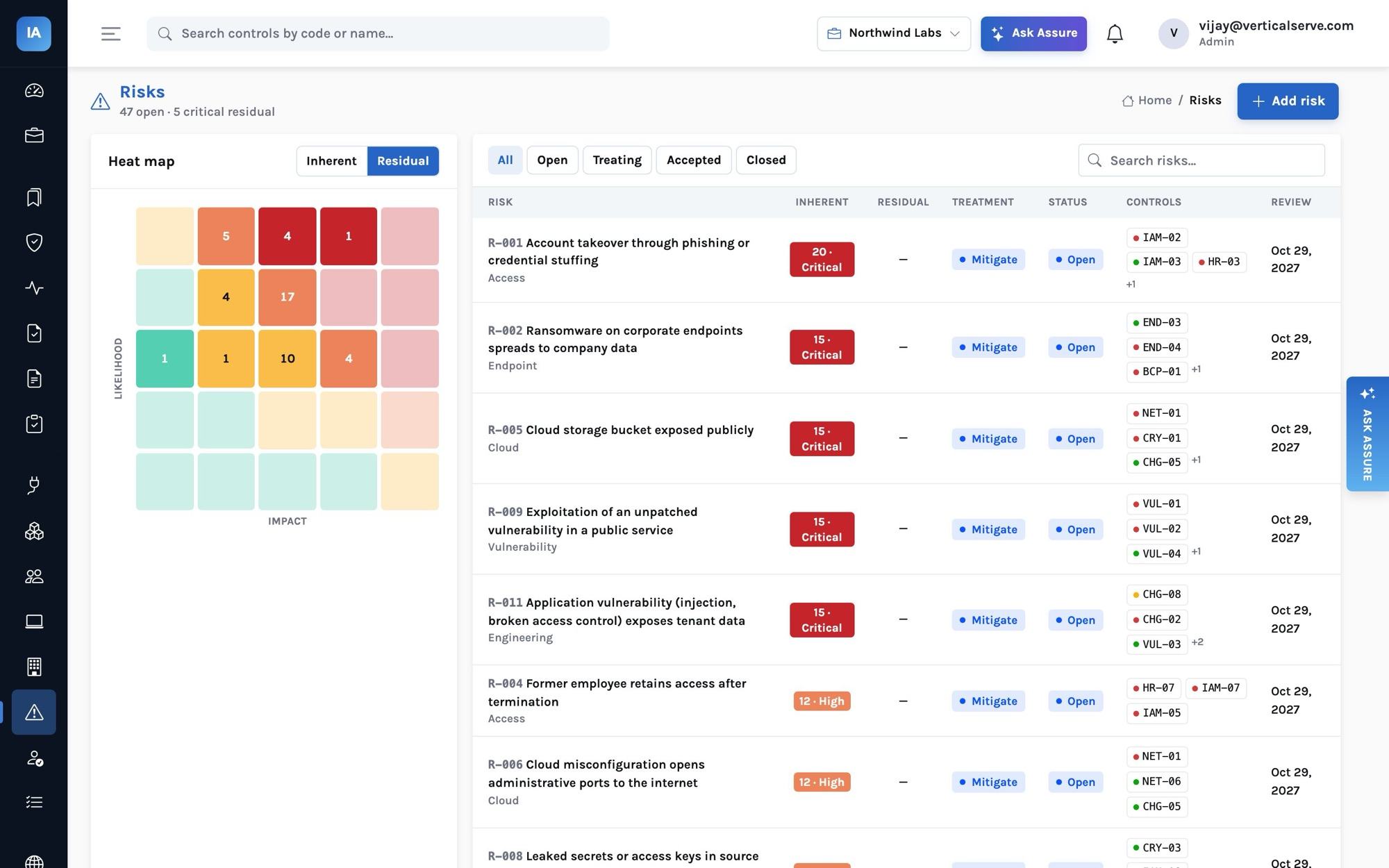
A library of 47 risks for a cloud company (account takeover, ransomware, vendor breach, public buckets, unpatched services, leaked secrets, key-person dependency, AI misuse) loads with likelihood and impact on a 1–5 scale and links to the controls that treat each one. Each risk carries an owner, a treatment (mitigate, accept, transfer, avoid), a plan, a residual score and a review date; accepting a risk records who accepted it.
A monitor checks that the register was reviewed in the last year and that every risk scoring 15 or more has an owner and a plan or an approved acceptance.
How it works
Third-party assurance that feeds your own controls
Questions it answers
What you can find out
Each one is answered on a screen you can open, and most can be typed into Ask Assure as they are.
Which critical vendors are due a review?Vendors → Review due
Whose SOC report has expired?Subservice organizations’ SOC reports are current
What does AWS’s report expect of us?The review’s CUECs and the controls that cover them
Which SaaS apps are unmanaged?Discovered SaaS
Which high risks have no plan?The risk register’s critical and high residual risks
Which controls reduce ransomware risk?R-002’s linked controls and their health
Outcomes
What teams do with it
Reviews on a calendar
Every critical vendor reviewed yearly, with the report on file.
CUECs closed, not just read
Each one mapped to the control that covers it.
A risk register people maintain
Owners, plans and review dates, monitored.
Where it stops. SOC reports are read by a person: InsightAssure records the outcome and the CUECs, it does not parse the PDF. Vendor questionnaires are sent and recorded, not hosted as a portal for the vendor.