- contact@verticalserve.com
- Continuous compliance, proven every hour

Continuous monitoring
Know before the auditor does
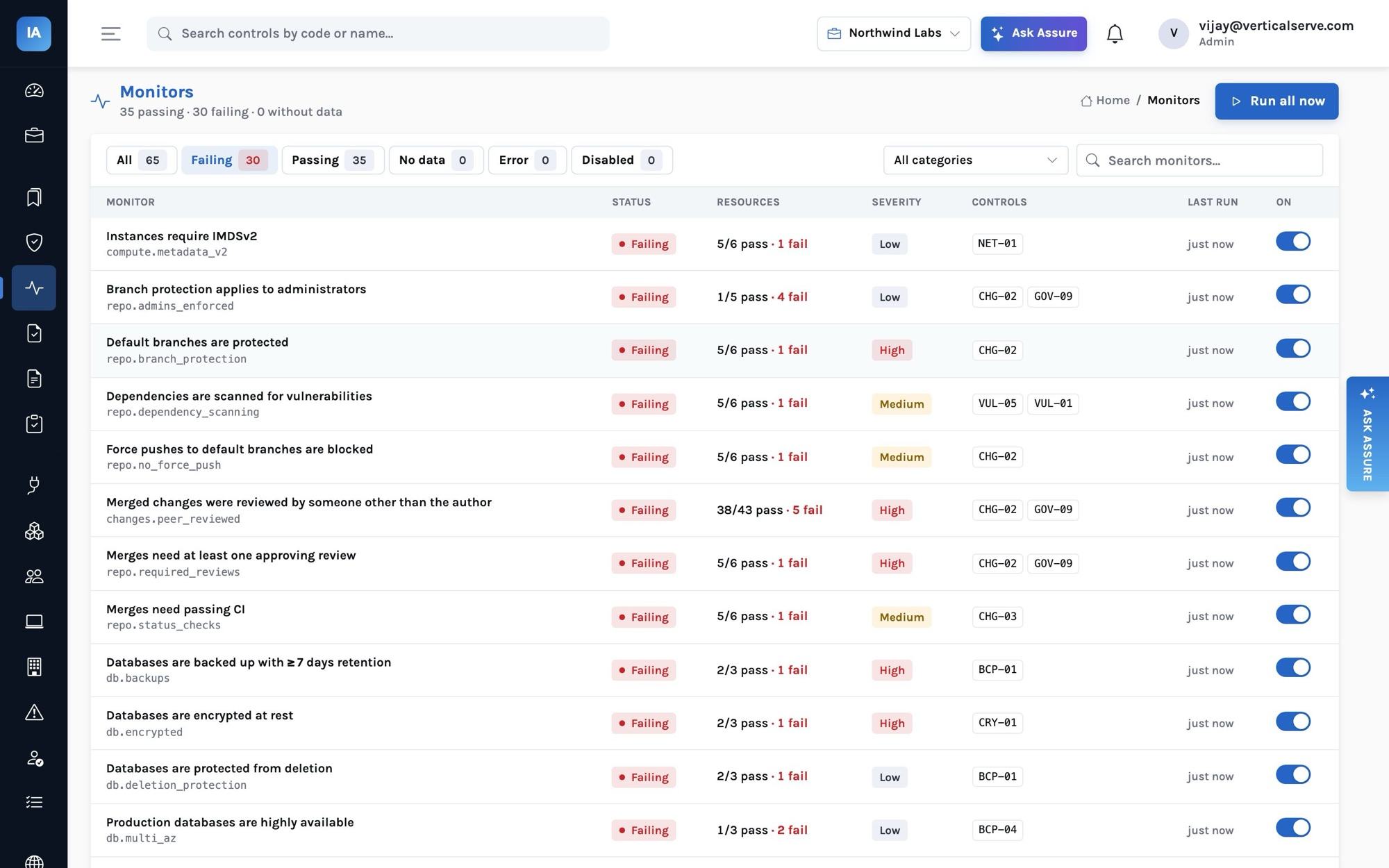
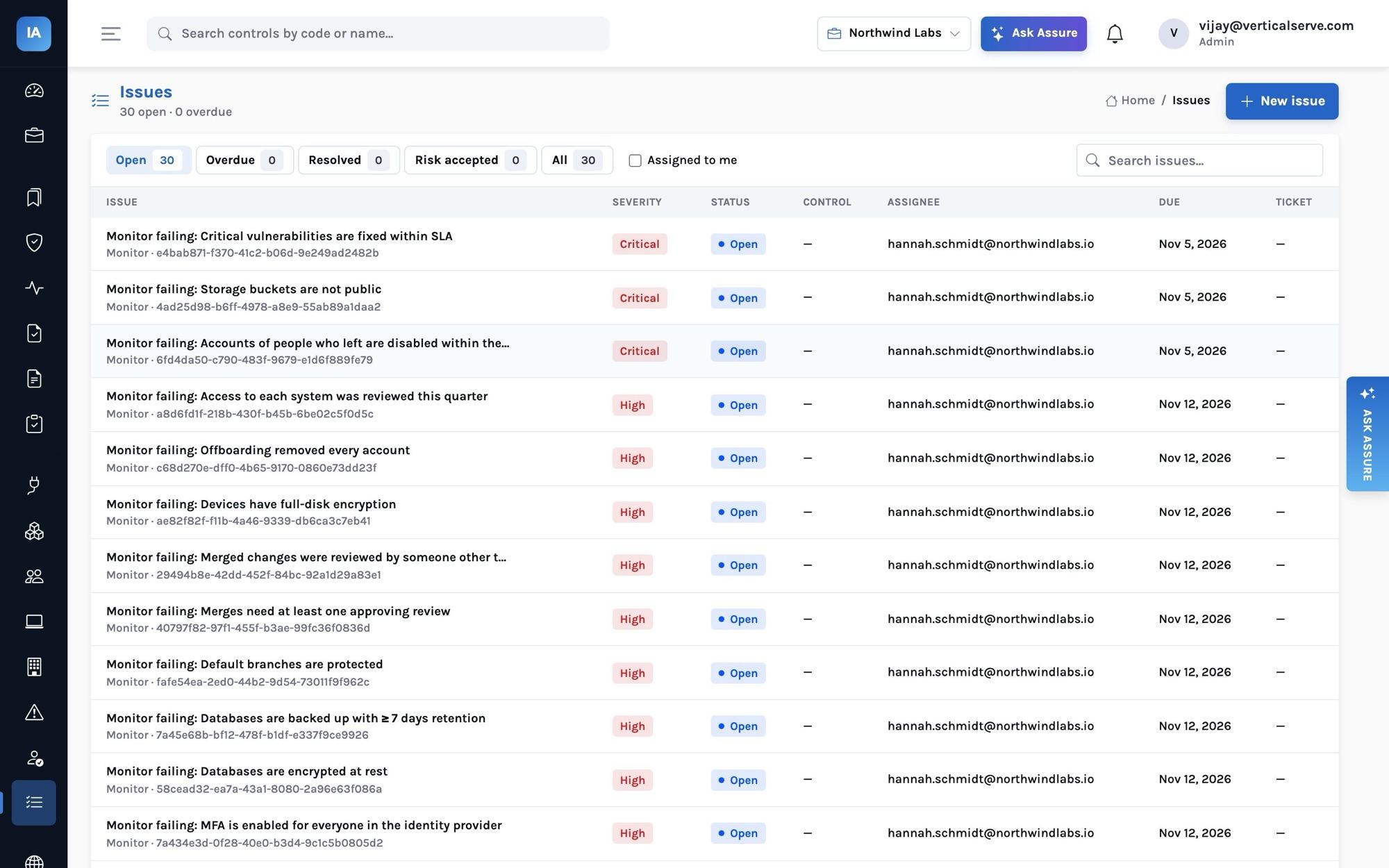
65 monitors judge your systems every hour. A failure names the resource and the reason, says how to fix it, opens an issue, and feeds the controls that depend on it.
Monitors
Every test, with what it covered
Each monitor reads normalized resource types (accounts, employees, devices, repositories, merged changes, buckets, databases, findings, incidents) or the program itself (policies, vendors, risks, access reviews). Its status is passing when nothing failed, failing when something did, and no data when there was nothing to judge, naming the kind of integration that would supply it.
- Identity: MFA in the IdP and every system, administrators with MFA, leavers disabled within the SLA, accounts with no known owner, 90-day inactivity, key age
- Cloud and data: root MFA, audit logging, threat detection, public buckets and databases, encryption, backups ≥ 7 days, SSH/RDP open to the world
- Code: branch protection, required reviews, status checks, force pushes, secret and dependency scanning, merged changes with an independent approval
- Vulnerabilities: critical, high and medium findings against the SLAs in Settings (15 / 30 / 90 days by default)
- Devices and people: disk encryption, screen lock ≤ 15 minutes, anti-malware, OS updates; policies accepted, training current, background checks
A failure
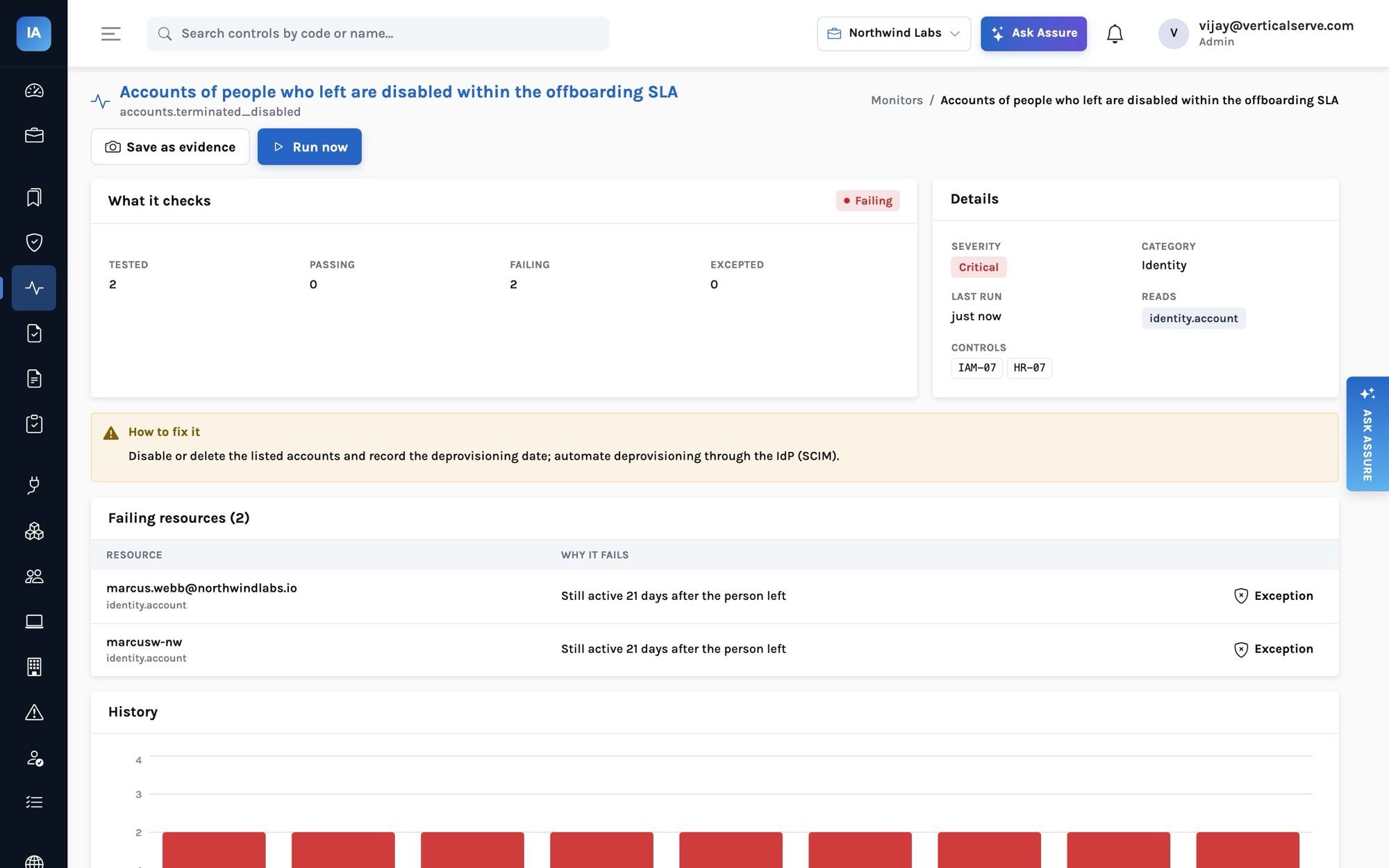
The resource, the reason, the fix
The demo company’s offboarding monitor found that Marcus Webb, who left 21 days earlier, still had an active Okta account and an active GitHub account. Both are named, with the reason, the remediation, and the controls they affect (IAM-07 Timely deprovisioning, HR-07 Offboarding).
When a failure is an accepted risk, record an exception for that resource with a reason and an expiry: it no longer fails the monitor, stays listed as excepted, and comes back when the exception expires.
Not judged when not reported
Unknown is not a pass, and not a failure
A monitor never fails a resource for data its source did not provide. If a connector cannot tell whether a GitHub member has two-factor authentication, that account is not judged by the MFA test; if every account is unknown, the monitor says no data instead of passing. An administrator is the exception: unconfirmed MFA on an admin account counts as missing.
As evidence
A monitor run, frozen for the auditor
Save as evidence freezes a monitor’s current result and the population it judged into a dated piece of evidence, linked to every control the monitor feeds. Snapshots taken across an observation period are what an auditor samples for a continuously monitored control; the full run history is kept for 400 days.
How it works
From a system to an issue: sync, normalize, test, record, raise
Questions it answers
What you can find out
Each one is answered on a screen you can open, and most can be typed into Ask Assure as they are.
Who left but still has access?The offboarding monitor and each leaver’s page
Which buckets are public?Storage buckets are not public, with the failing buckets
Which merged changes had no independent approval?Merged changes were reviewed by someone other than the author
Which critical vulnerabilities are past SLA?Critical vulnerabilities are fixed within SLA, with each finding’s age
Which laptops are unencrypted?Devices have full-disk encryption, by device and owner
What did this monitor show last quarter?The monitor’s history, or a saved snapshot
Outcomes
What teams do with it
Gaps found in hours, not at fieldwork
A leaver’s account or a public bucket shows up on the next hourly run.
Remediation with an owner and a date
Every failure becomes one issue, due by severity, closed when it is fixed.
Evidence that collects itself
Run history and snapshots replace screenshots taken the week before the audit.
Where it stops. Monitors judge what integrations report. A source that does not expose an attribute (for example Slack’s two-factor flag on free plans) leaves it unjudged, and checks that need a person’s judgement, such as a restore test or a tabletop exercise, are evidence you upload, not monitors.